
Can Pilates help hypermobility and hEDS? Yes — modified, classical Pilates is one of the most recommended forms of exercise for hypermobile Ehlers-Danlos syndrome (hEDS) and Hypermobility Spectrum Disorder, because it builds joint stability, body awareness, and deep muscle control instead of adding more flexibility where it isn’t needed. At Reformation Station Pilates this stability-focused, classical Pilates training is what we specialize in.
Why do hypermobile people feel tight if they are flexible?
If you are hypermobile, this will sound familiar: you can bend further than most people, and yet you feel tight all the time. Tight hamstrings, tight hip flexors, a tight neck and shoulders. You stretch, you feel better for a little while, and then it's right back.
In hEDS and hypermobility, the ligaments that should help hold a joint together are lax. The joint has too much movement, so your nervous system asks the muscles around it to grip instead. That gripping is called guarding. The big muscles meant to move you take over holding you together, get overworked and sore, and feel tight — not because they are short, but because they are working overtime. You can be loose in your joints and tight in your muscles at the same time.
Is stretching bad for hypermobility?
Stretching a guarding muscle briefly removes the protection, and stretching into end range can destabilize the joint a little further. Your body senses the instability and tightens again: instability → guarding → tightness → stretching → more instability.
Breaking the cycle is not about more flexibility. More range is rarely the problem. Control of the range you already have is.
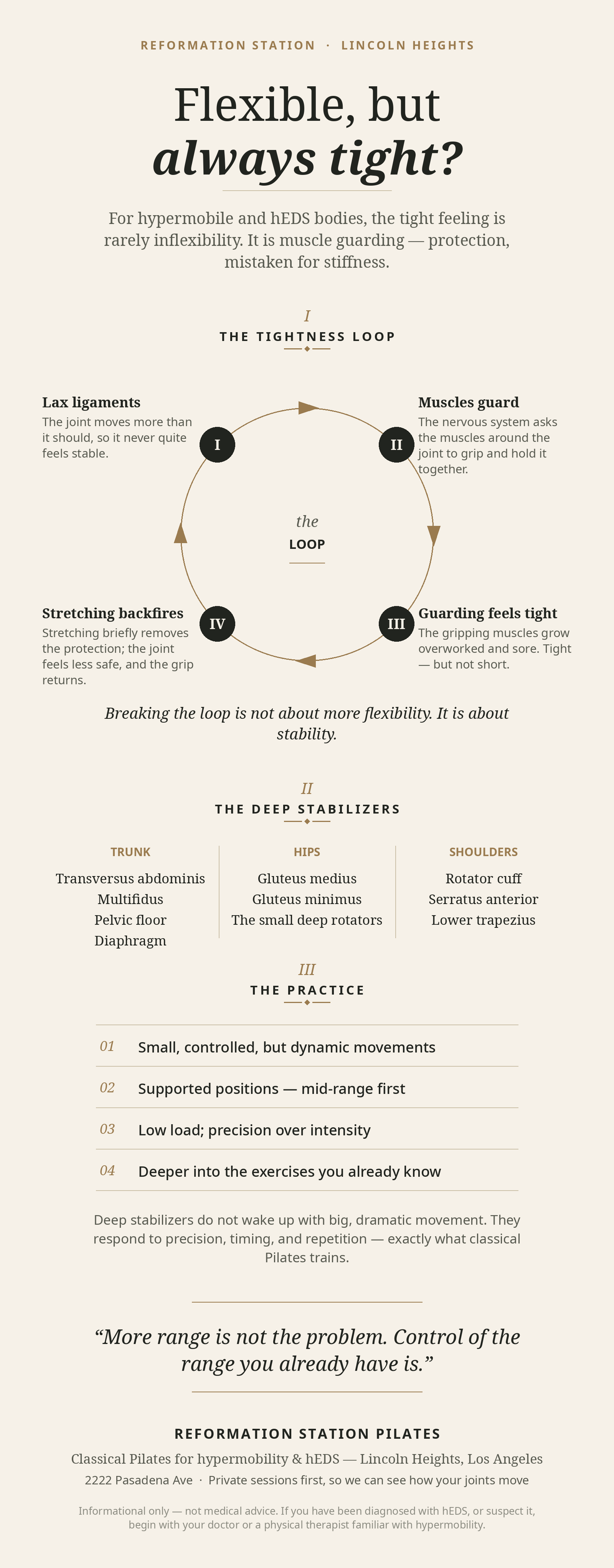
Hypermobile bodies feel tight because lax ligaments destabilize joints, muscles guard to protect them, and stretching backfires. Training the deep stabilizers with classical Pilates helps. Reformation Station Pilates, Lincoln Heights, Los Angeles.
What should hypermobile bodies train instead? The deep stabilizers
Underneath the gripping muscles is a quieter system: the deep stabilizing muscles, close to the joint, meant to fire before you move — transversus abdominis, multifidus, pelvic floor and diaphragm in the trunk; the deep neck flexors; the rotator cuff at the shoulder; gluteus medius, minimus and the small deep rotators at the hip. When they do their job, the big muscles can finally stop gripping, and that is when the feeling of tightness starts to change.
Why small, controlled Pilates exercises work for hEDS
The exercises that wake up the deep stabilizers are small. Controlled, slow, often barely looking like exercise at all. You may finish and think, "Did I even do anything?"
Yes — you did exactly what your body needed. Deep stabilizers don't respond best to heavy load or big range. They respond to precision, timing, breath, and repetition, until support becomes automatic. A small movement done with real control can be more beneficial for a hypermobile body than a dramatic movement done by gripping through it.
This is what classical, traditional Pilates focuses on — and it is the Pilates we teach at Reformation Station. Not novelty, not inventing new exercises every week, not chasing the biggest range possible. Going deeper into the work you already know. The apparatus gives support and feedback, the springs can assist as well as resist, and the same foundational exercises teach your body to stabilize from the center out, a little more every time.
Pilates for hypermobility in Northeast Los Angeles
Pilates does not cure Ehlers-Danlos, and if you have been diagnosed — or suspect you might have it — start with your doctor or a physical therapist familiar with hypermobility. What well-taught Pilates can do, and why doctors and physical therapists so often point hypermobile patients toward Pilates-based work, is help you build the strength, proprioception, and control your ligaments cannot provide on their own.
If you are flexible but always feel tight, you may not need another stretch. You may need to get strong in the smallest, quietest way possible.
Reformation Station Pilates, 2222 Pasadena Ave, Lincoln Heights, Los Angeles — serving Highland Park, Mount Washington, Glassell Park, Echo Park, Downtown Los Angeles, Pasadena, and Glendale. If you are hypermobile and would like to explore whether this work is right for your body, the best way to start is with a private session, so we can see how your joints move and where your body is guarding before you join a class.
Frequently asked questions
Is Pilates good for hypermobile Ehlers-Danlos syndrome (hEDS)?
Yes, when it is focusedfor hypermobility. Classical Pilates builds deep stabilizing strength, joint control, and body awareness with low load and controlled range — exactly what lax joints need — instead of stretching them further.
Why do I feel tight when I'm hypermobile?
Because your muscles are guarding. When ligaments are lax, muscles around the joint stay partly contracted to protect it. That guarding feels like tightness, even though the muscle is not short.
Should people with hEDS stretch?
Gentle, dynamic movement is usually fine, but repeatedly stretching unstable joints into end range can make instability and guarding worse. For most hypermobile bodies, stability and strength help more than flexibility work.
Where can I do Pilates for hypermobility in Los Angeles?
Reformation Station Pilates in Lincoln Heights specializes in classical, stability-focused Pilates for hypermobile clients, including private sessions for hEDS and joint instability, serving Northeast Los Angeles, Pasadena, and Glendale.
Do I need a private session before joining a Pilates class if I'm hypermobile?
Yes — a private session first lets a teacher see how your joints move, where your body guards, and which ranges are safe for you before you are in a group class.
Reformation Station Pilates is a classical, traditional Pilates studio in Northeast Los Angeles specializing in private, stability-focused training for hypermobile bodies, including clients with hEDS and joint instability. Located at 2222 Pasadena Ave in Lincoln Heights, the studio serves clients from Highland Park, Mount Washington, Glassell Park, Echo Park, Downtown Los Angeles, Pasadena, and Glendale who need control and strength — not more stretching.
New to The Reformation Station? Everyone starts with a New Client Package of private sessions, so we can see how your body moves before you join a class. See the Getting Started page or call/text (323) 227-1877.